
How to build raised garden beds
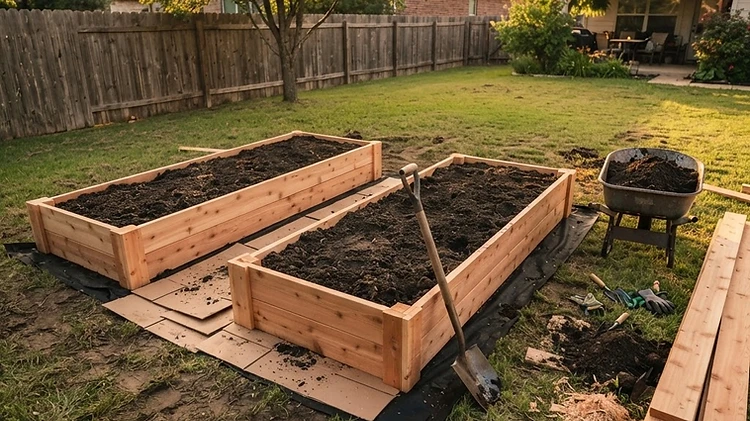
Two 4 ft by 8 ft raised beds take a weekend and just under two cubic yards of soil. The one call that matters first is 811: it is free, it marks gas, power and water lines, and it usually answers within two business days.
Skill level
Beginner
Time
A weekend: about 7 hours for two 4 ft x 8 ft beds
Materials
$340 – $620 for two beds, soil included
Tools
10 on the list
Work out your own quantities
Turn your own measurements into a board count before you go to the store.
Open the lumber calculatorTools you will need
If you own none of these, buy the cheap version of each — they are all reusable.
- Tape measure and string line
- 4 ft level
- Circular saw or handsaw
- Drill and driver
- Spade and shovel
- Wheelbarrow
- Work gloves
- Eye and ear protection
- Rubber mallet
- Garden rake
Materials list, with the math
Quantities are worked out for the size of job described above, and the arithmetic is shown so you can adjust it for your own space.
2 x 6 x 8 ft boards, cedar or pressure-treated
12 · $12 – $20 each
Each bed takes six boards: four 8 ft sides, two per course, and two more cut into the four 4 ft ends. Two beds take 12. Two courses of 2 x 6 make the bed 11 in deep, which is the depth the soil math below assumes.
4 x 4 x 8 ft post
1 · $14 – $22
One post cuts into eight 12 in corner blocks: four per bed, two at each corner, tying both courses together. Eight blocks come out of a single 8 ft post exactly.
3 in exterior screws
1 box · $10 – $16
Four screws per corner joint, eight joints per bed, so 32 screws a bed and 66 for the job including the two where the beds meet. One small box covers both beds.
Cardboard or landscape fabric
64 sq ft · $15 – $30
Two 32 sq ft beds need 64 sq ft of ground cover. Cardboard is free, breaks down in a season and feeds the soil; landscape fabric lasts longer but has to be laid flat with no folds.
Soil blend: 60% topsoil, 30% compost, 10% perlite
48 cu ft · $3 – $6 per cu ft
One bed is 4 x 8 x 0.75 ft of soil, which is 24 cu ft, so two beds need 48 cu ft. In bulk that is 48 / 27 = 1.8 cubic yards; by the bag it is 12 two-cubic-foot bags per bed, so 24 bags for two beds.
Food-safe wood sealer, if the timber is untreated
1 qt · $14 – $22
A quart covers about 100 sq ft, and the outside faces of both beds come to about 60 sq ft. Cedar and larch do not need it, fir and pine do.
Estimated total
$340 – $620 for two beds, soil included
The steps, in order
10 steps, in the order you would actually do them, with a time estimate for each.
- 1
Pick the site and check the sunlight
Vegetables want six to eight hours of direct sun. Watch the spot at mid-morning and mid-afternoon before committing, and keep the beds 3 ft clear of a fence so you can work down both long sides.
about 30 min
- 2
Call 811 before you break the ground
Call 811 or book the request online at least two to three business days before digging. The service is free and it marks gas, power, water, sewer and telecom lines on your property. Striking a gas or power line is the reason this call is not optional.
about 10 min
- 3
Mark the footprints and check them square
Set string lines to two 4 ft by 8 ft rectangles, 3 ft apart for a wheelbarrow to pass. Measure both diagonals of each rectangle: when the two diagonal measurements match, the corners are square.
about 20 min
- 4
Strip the grass and level the ground
Cut the grass out, or lay cardboard over it, and scrape the ground flat under each footprint. A frame sitting on a lumpy surface looks crooked from a distance and rocks while you build on it.
about 60 min
- 5
Cut the boards and pre-drill
Cut four 8 ft sides and four 4 ft ends per bed, then pre-drill every screw hole with a bit slightly narrower than the screw. Pre-drilling is what stops treated timber from splitting at the ends.
about 45 min
- 6
Build the frames
Make each bed as a rectangle of two stacked courses, with a 12 in post inside each corner screwed through both courses. Keep checking the diagonals as you tighten, because a frame that goes out of square is impossible to pull back later.
about 60 min
- 7
Set the frames in place and level them
Drop each frame onto its footprint and check the level in both directions. Bed a little soil or sand under the low corner rather than levering the frame, and line the two beds up with each other while they are still light.
about 45 min
- 8
Line the bottom for weeds
Two or three layers of cardboard, or one layer of landscape fabric, across the whole footprint. Never plastic sheeting: it blocks drainage, and a bed with a blocked base fills up like a bathtub after a storm.
about 20 min
- 9
Fill and settle the soil
Fill to within 2 in of the top, mixing topsoil, compost and perlite as you go, then water it in, let it settle, and top it up. A bed filled with straight topsoil dries into brick, which is what the compost and perlite prevent.
about 90 min
- 10
Water, plant and mulch
Soak the soil the day before planting, then plant to the spacing on the packet, about 24 in for tomatoes and 12 in for lettuce, and mulch 2 in deep to hold the moisture in and keep the weeds down.
about 45 min
Safety notes
Before you start
- Call 811 before you dig below the surface, every time. Hitting a gas line or a buried cable is a real danger and an expensive one, and the marking service is free.
- Wear gloves and eye protection when cutting timber, and ear protection with a circular saw.
- Do not use old railroad ties, or any timber treated with creosote, for a bed that grows food.
- Modern pressure-treated lumber, marked ACQ or CA, is considered safe for vegetable beds. If you would rather avoid it, cedar and larch are the untreated options and last about 8 to 10 years.
- Lift the soil bags with your legs: a damp 2 cu ft bag weighs 60 to 80 lb, and 48 cu ft is a lot of lifting.
- Never build a bed over a septic field or a tank lid, keep clear of the gas meter, and stay out of any utility easement.
- Keep beds under 2 ft tall unless the sides are designed as a retaining wall, because wet soil pushes outwards hard.
Hire a licensed pro if
Hand these to someone licensed
- The ground drops more than 12 in across one bed's footprint, which is a terracing or retaining job rather than an afternoon with a shovel.
- There is standing water in the spot after rain. The drainage has to be sorted out before any timber goes down.
- A buried service crosses the footprint, or the bed would sit within a few feet of a gas meter or inside an easement.
- You want beds taller than 2 ft, where the walls have to be designed and built as a retaining structure.
- The beds are going on a deck or a roof, where the load on the structure needs checking first.
Frequently asked questions
- Do I have to call 811 before building a raised bed?
- Yes if you are breaking the ground or setting anything below the surface. It is free, takes a few minutes, and the locating service usually marks the lines within two business days. If you build straight on top of the surface with no digging at all, you can skip it.
- Is pressure-treated wood safe for vegetables?
- Modern pressure-treated timber, marked ACQ or CA, is widely accepted as safe for food crops. If you would rather avoid it, cedar and larch are untreated, last about eight to ten years and cost more.
- Which wood lasts longest?
- Cedar and larch are the untreated long-lifers. With treated timber, look for ACQ or CA, and rest the boards on gravel or a post rather than straight on wet soil, because the bottom edge is always the first to rot.
- How much soil do two 4 ft by 8 ft beds need?
- About 48 cubic feet, which is 12 two-cubic-foot bags per bed, so 24 bags for both beds. In bulk that is 1.8 cubic yards, so if you can take a delivery, two yards is usually cheaper and easier than moving the bags by hand.
- Do I need to remove the grass underneath?
- No, if you smother it: three overlapping layers of cardboard does the job in a season and feeds the soil as it breaks down. Remove the grass only if it is tall or coarse, or if the ground needs levelling anyway.
Related guides


Plan this in your own space
Two or three photos of your own room, yard or garage is enough. The app reads the space, then sizes the materials and the steps to what you actually have.
Plan this in your own space